If you’re anxious about AI-driven mass unemployment, consider this question first:
In 2025, how many people’s jobs require absolutely no computer or smartphone?
If your answer is “very few,” keep that in mind as you read on. We’ll calculate the actual number midway through this article.
Over the past two years, AI anxiety has spread like a super-contagion. We worry about ourselves — will a white-collar worker who’s spent a decade making PowerPoints and spreadsheets be replaced within three years by a fresh graduate who’s better at prompting, or even by an agent? We worry about our children — if we enroll them in art, coding, or finance classes now, will those industries still exist when they graduate twenty years from now?
This anxiety isn’t baseless. Regardless of whether AI ultimately leads to universal prosperity or a post-dystopia, nearly every authoritative institution is amplifying the short-term pain.
The World Economic Forum’s 2025 Future of Jobs Report bombards us with charts, all converging on “structural transformation” and “skill disruption.” PwC’s 2025 Global AI Jobs Barometer is even more blunt: in industries “more susceptible to AI influence,” per-employee revenue growth is three times higher than in other sectors, and the pace of skill change is 66% faster.
Even OpenAI — the very instigator — can’t resist fanning the flames. In their Working in the Intelligence Age report, they cheerfully share how Walmart uses large language models to process product data, claiming that “without generative AI, the same work would require nearly 100 times the existing workforce to complete in the same timeframe.”
Translation: the technology is amazing, change has arrived, and if you don’t learn, get out.
This logic is so airtight that “lifelong learning” and “embrace AI” have become the only acceptable positions of our era.
But…
There’s always a “but.”
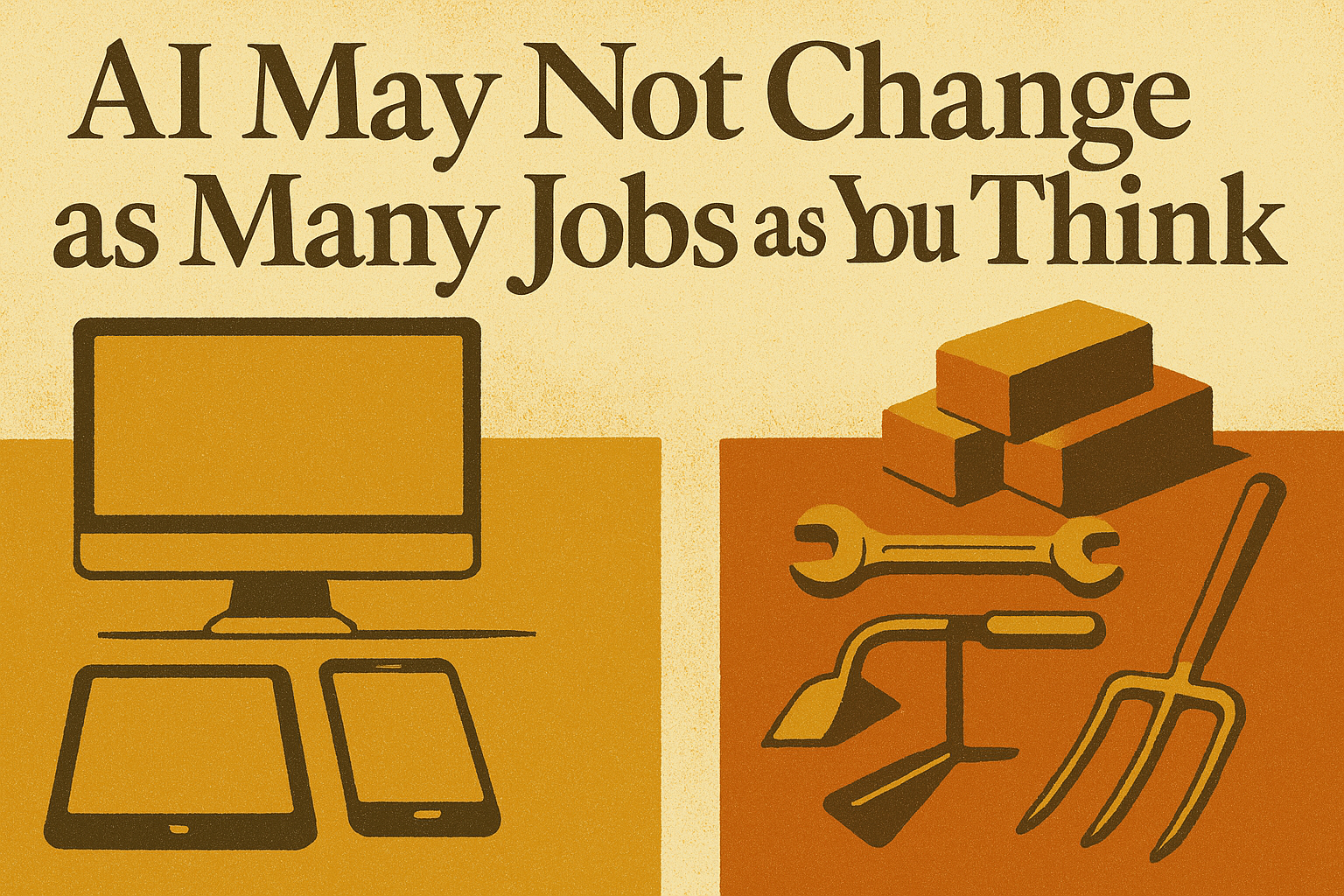
Here it is: we’ve taken for granted a premise — that AI is a higher form of “intelligence” that will replace human “intelligence.” The reality is that a significant portion of jobs in this world don’t require that kind of intelligence at all. They don’t even need the intelligence humans currently possess.
Put differently, they don’t need “cognitive intelligence.” They need “physical intelligence.”
A software engineer’s entire job exists in the digital world. AI, as a more efficient digital processing tool, can naturally assist, augment, or even replace them.
But what about a construction worker? His job is hauling, laying bricks, and tying rebar. What he needs to learn is how to use his lower back properly to avoid injury. A prep cook chopping vegetables in the back kitchen, a security guard patrolling a residential compound, a farmer planting rice seedlings, a factory worker tightening screws on an assembly line, a cleaning lady tidying an office — these jobs share a common trait: their primary objects of operation remain physical “atoms” in the real world.
Sure, they use smartphones to watch short videos and chat with family on WeChat. But in their core workflows, what they need is a pair of hands, a pair of legs, and physical presence. Unless humanoid robots can be perfected and brought down to an extremely low price point in a very short time, these jobs will be virtually unaffected.
And pouring AI’s “digital intelligence” into “physical atoms” is extraordinarily expensive. Talking about AI replacing programmers is a yes-or-no question. Talking about AI replacing security guards is an ROI question. In the latter domain, the physical cost of human labor is astonishingly low.
So how large is the group represented by this “but”?
To find out, I had AI run two estimation reports — one for China, one for the world. I deliberately told it not to cite those sweeping “AI will affect X% of jobs” reports. Instead, I asked it to work from the most fundamental global labor structure data (such as the ILO and national statistics bureaus) to estimate a floor:
How many people’s jobs, at their core, are “non-digitally dependent” — completely independent of smartphones and computers?
The results are staggering. Let’s start with China.
The report used two methodologies for cross-validation, based on China’s 740 million employed workers in 2023.
The first is a “top-down” approach. It draws on the officially published National Digital Literacy and Skills Development Level Survey Report (2024), which shows that 67.85% of employed workers possess at least basic-level digital literacy.
Working backward, 32.15% of employed workers (approximately 238 million people) lack even basic digital literacy.
Note that this is merely a floor. It estimates people who “cannot participate in digital work due to skill deficiency.” In reality, many people (like residential security guards) “possess” the skills (they can use Excel) but their “positions” don’t require them.
So the second “bottom-up” estimate is closer to the truth. It doesn’t care what people “can” do — only what their “positions” require.
It breaks down by the three economic sectors:
-
Primary sector (agriculture): Approximately 163 million employed workers. The report assumes at least 85% of this work (field labor such as planting and animal husbandry) is purely physical. That’s 138 million people. They may use their phones to check weather or sell produce, but “farming” itself is non-digital.
-
Secondary sector (industry and construction): Approximately 212 million employed workers. After excluding highly automated “smart manufacturing” facilities and management positions, the estimate focuses on construction, low-end manufacturing, and mining — physical laborers. This totals approximately 106 million people. They are the workers hauling bricks on construction sites and the assembly workers performing repetitive labor on production lines.
-
Tertiary sector (services): This is the most complex part, totaling approximately 358 million workers. It includes both highly digitalized fields (finance, IT, research — about 100 million people), a middle zone (teachers, doctors, drivers), and purely physical laborers. The estimate conservatively extracts those “in-person service” physical laborers — housekeeping, cleaning, security, restaurant kitchen staff, etc. This comes to approximately 50 million people.
Adding the three together: 138 million (agriculture) + 106 million (industry/construction) + 50 million (services) = 294 million people.
The conclusion: In China, roughly 4 out of every 10 workers (32.15% to 39%) perform jobs whose core processes require absolutely no operation of computers, tablets, or smartphones.
This doesn’t even include delivery drivers and ride-hailing drivers — jobs that don’t require much digital operation but are strongly tied to the internet.
The highlighted estimates were generated by AI using verified statistical data and specific calculation methods. When the same prompt was run multiple times across different Deep Research modes in Gemini and ChatGPT, the percentages fluctuated between 35% and 45%, but never fell below 35%.
Has this number already upended your perception of “digital China”?
Don’t rush — China’s labor digitization rate is actually quite high. Let’s look at the global picture.
The global calculation uses the same “bottom-up” labor sector decomposition method, with data primarily from the International Labour Organization and a denominator of 3.7 billion total workers.
It divides the global “physical workforce” into three major categories:
-
Agricultural workers: Globally, this remains the largest “physical labor” group. Estimated at approximately 829 million people, constituting 38% of the global physical workforce.
-
Informal service workers: This is the “base color” of the global economy — domestic workers, street vendors, small traders, artisans. They form the bulk of the world’s poor, and their work is highly physical. Estimated at approximately 766 million people (35%).
-
Industrial physical laborers and physical laborers in the formal service sector: Including construction workers, non-digitized factory workers, and cleaning and security staff in the formal service sector. Estimated at approximately 573 million people (27%).
Adding them up: 829 + 766 + 573 = 2.168 billion people.
The conclusion: As of 2025, approximately 58.6% of the global workforce requires absolutely no computer operation in their work.
The highlighted estimates were generated by AI using verified statistical data and specific calculation methods. When the same prompt was run multiple times across different Deep Research modes in Gemini and ChatGPT, the percentages fluctuated between 45% and 60%, but never fell below 45%.
At least half.
This means that the personal computer revolution (starting in the 1980s), the internet revolution (starting in the 1990s), and the mobile internet revolution (starting in the 2010s) — these three massive waves, over nearly half a century — haven’t even managed to “digitize” half the world’s jobs.
We — the people who work 10 hours a day in front of screens, anxiously tracking every AI development — represent less than half of the workforce. We mistake ourselves for the whole world, but we aren’t even the majority.
Now let’s look at AI’s impact through this lens.
Of course, saying AI has zero impact on nearly 50% of the “physical workforce” would also be inaccurate. For truck and taxi drivers, for instance, ride-hailing created an existential crisis for traditional cabbies a few years ago. But ride-hailing drivers and taxi drivers share essentially the same labor skills — it was more of a lateral shift than a replacement.
One could even argue that mobile internet created three massive “employment safety nets” from scratch: food delivery riders, ride-hailing drivers, and couriers.
The AI era will most likely follow the same pattern. AI will reorganize digital workflows and create new demand that didn’t previously exist (for example, AI generating 1,000 personalized product proposals). But AI itself cannot cover all the “physical steps” needed to fulfill that new demand (who’s going to prototype, package, and deliver those 1,000 personalized products?).
These “physical gaps” — created by AI-driven efficiency gains that AI itself cannot fill — are precisely one source of new jobs AI will create. Yet even so, a tragicomic paradox emerges:
A “non-digitally dependent” worker who missed the computer wave over the past 30 years, missed the internet wave, and even in the smartphone era only used their phone for entertainment…
…turns out to be in the safest position during this AI wave.
AI is hitting precisely the people who “won” in the last wave — those who work with “digital intelligence.”
The financial analyst crunching data in a cubicle is in more danger than the construction worker mixing cement on a job site. The graphic designer retouching images on a computer is in more danger than the prep cook chopping ingredients in the back kitchen. The programmer typing away at a keyboard is in more danger than the cleaning lady tidying the office.
Because the cost of AI replacing “digital work” (computing power, electricity) is plummeting, while the cost of replacing “physical work” (robot hardware, maintenance) remains steep.
And this reveals the true nature of “AI anxiety” — it is fundamentally an elitist anxiety, a modern version of “let them eat cake.”
Why?
Those “physical” jobs — the ones nearly half the world depends on for a living — what do they typically entail? We all know: lower income, harsher conditions, heavier physical toll.
The 2.1 billion people globally, or 300 million in China, have always lived with “danger.” Not the danger of being replaced by AI, but the danger of poverty, workplace injuries, scorching heat, bitter cold, and physical exhaustion.
Yet in the grand narrative of the “AI revolution,” this half of humanity is the silent majority. Their “danger” is treated as background scenery — as an unacceptable outcome.
Now, when AI appears, the 40% who constitute the “digital workforce” (that is, us) start panicking. What are we anxious about? We’re anxious about “losing our jobs.”
But what we truly fear is “sinking” — we’re terrified of having to leave our comfortable air-conditioned offices to do the physical labor we once “overlooked.” We’re afraid of going from “analysts” and “programmers” to “construction workers” and “cooks.”
This, in itself, is a perspective that doesn’t treat most people as fully human.
So this fear of “sinking” — this anxiety of “I don’t want to become a construction worker” — perhaps what it should really drive us to do is not frantically competing to learn AI, scrambling for the shrinking number of “digital” positions within that 40%.
Instead, it should compel us, for the first time, to truly confront the reality of that 60%. It should drive us to ask: Why are the conditions and compensation for “physical labor” so terrible that we view it as “the end of the world”?
This fear is, in fact, the best possible motivation for improving the working conditions of those 300 million — or 2.1 billion — people.
To put it more bluntly, perhaps AI’s greatest contribution will be sweeping everyone out of the illusion of “knowledge work” and forcing everyone to “sink” into the realm of “physical labor.”
Because only then will “improving working conditions” become a societal consensus for the first time.
After all, when everyone becomes a construction worker, the former meritocrats can no longer use the nonsensical excuse of “I sit in an office because I studied hard” to turn a blind eye to others’ heat subsidies and workplace injury insurance.
So when we talk about “AI changing work,” we may have gotten one thing wrong. What AI brings may not be an “intelligence revolution” targeting all of humanity. It’s more like an “internal reshuffling” and “class panic” targeting that 40% of the digital workforce.
It can’t change the physical reality of those 300 million Chinese workers, nor the physical reality of those 2.1 billion global workers.
Seen this way, AI may indeed change (our) work — but to say it will change (everyone’s) work? That’s still a long way off.
Next time a “digital elite” tries to sell you AI anxiety and urges you to “embrace change” and buy their course immediately…
You can nod politely, then ask: “So… have you signed up for culinary school yet?”