Table of Contents
Contents
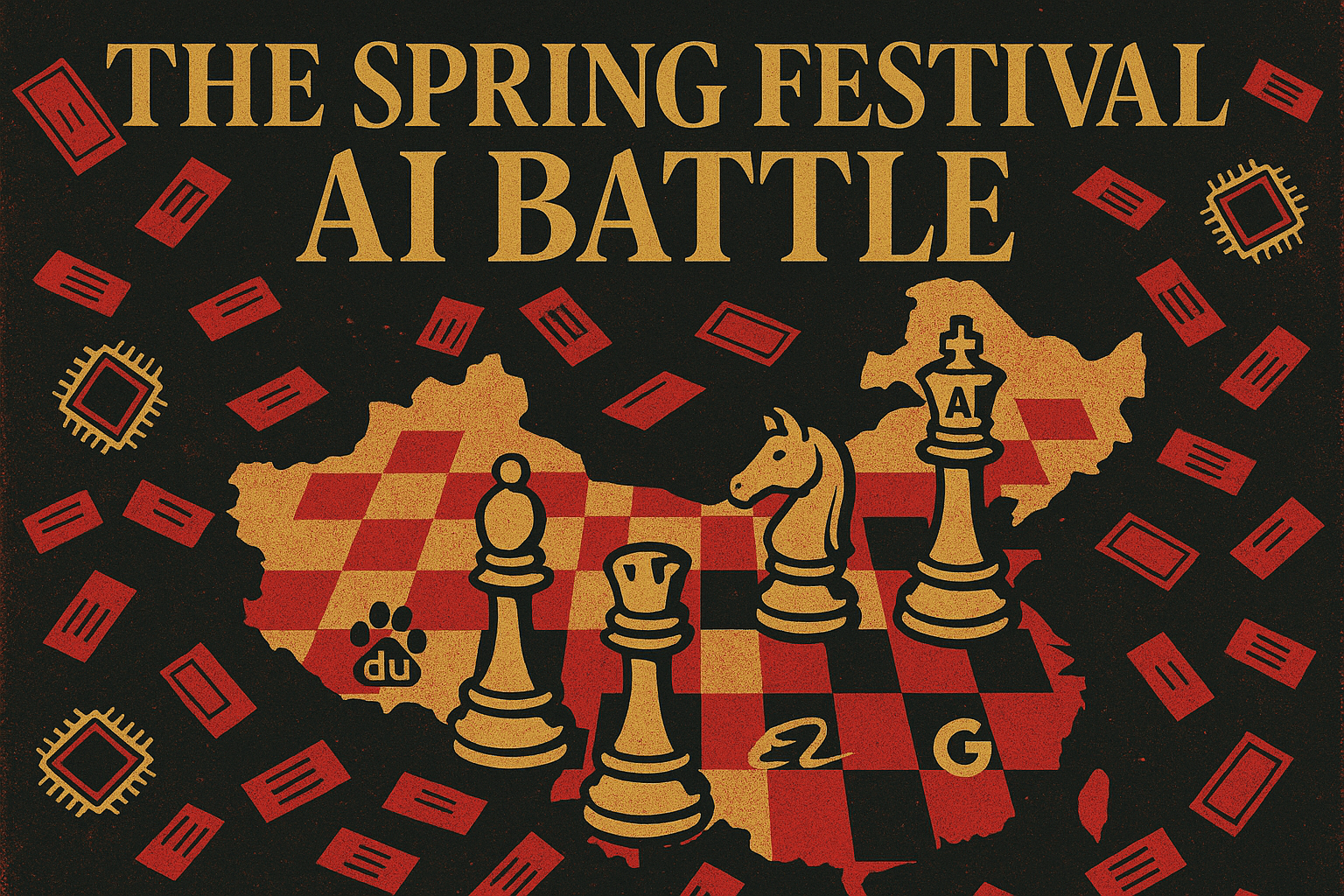
February 16, Lunar New Year’s Eve. In Beijing’s Zhongguancun district, lights blazed in the Dinghao Building housing ByteDance. Over at Xierqi, Baidu’s Science Park kept entire floors lit up. To the south, Alibaba’s Xixi Campus in Hangzhou and Tencent’s headquarters in Shenzhen were similarly refusing to slip into holiday mode.
This Year of the Horse, China’s tech industry canceled vacations at unprecedented scale, launching the first premeditated, large-scale, resource-intensive frontal assault in Chinese AI history.
As we noted in prior coverage, over the past two decades, China’s tech giants have fought across virtually every major internet battlefield — from e-commerce and local services to long- and short-form video, social networking, gaming, mobile payments, and enterprise software.
Previous campaigns were localized skirmishes: lose one hand, and the game continues. This time felt more like a “Battle of Midway” — a turning point in a total war. Lose this, and you might lose the entire future.
ByteDance invested over 1 billion yuan. Doubao (豆包) deeply integrated into the CCTV Spring Festival Gala, distributing hundreds of millions in red packets and gifts. Alibaba sponsored four provincial satellite TV galas, deploying its AI assistant Qwen app with a 3 billion yuan Spring Festival promotion budget. Tencent invested 1 billion yuan, Baidu 500 million yuan — all funneling traffic toward their AI applications.
Tencent struck first. Alibaba committed even more resources to follow. ByteDance concentrated its firepower on Gala night itself. Subsidies, traffic, and prime ad slots were all pushed to the limit simultaneously, all fighting for the same pool of users.
China’s AI application penetration rate was forcibly accelerated. During the Spring Festival, hundreds of millions of people used AI to write New Year’s greetings, generate images, check travel itineraries, order food delivery, and buy movie tickets. ByteDance reported that on New Year’s Eve, Doubao’s total AI interactions reached 1.9 billion. Alibaba announced that nearly 200 million users used Qwen for one-tap ordering — milk tea, flight and hotel bookings, movie tickets. Tencent disclosed that Yuanbao’s daily active users surpassed 50 million, with monthly actives hitting 114 million.
No company wins the final war by winning the first battle. In AI especially, a clear gap remains between current technological maturity and genuine high-frequency user needs. When subsidies recede, how many users will proactively return? That’s the question everyone must face.
The second and third rounds are already brewing.
The Opening Moves
The CCTV Spring Festival Gala was this year’s core battlefield.
In 2015, WeChat used the Gala to popularize WeChat Red Packets, adding approximately 200 million linked bank cards to WeChat Pay in a matter of days. Since then, Alipay, Baidu, Taobao, JD.com, Douyin, Pinduoduo, Kuaishou, and Xiaohongshu have all partnered with the Gala in various forms.
In recent years, as the Gala’s overall influence and buzz have retreated from their peak, almost no product after WeChat has managed to replicate that growth miracle on this stage. Even so, for internet products, it remains one of the broadest-reach channels for exposure and user acquisition during the Spring Festival.
In late 2025, the new Gala production team followed tradition and canvassed multiple internet companies for partnership interest. An insider revealed they had positioned this edition as the “inaugural Digital Intelligence Gala,” hoping to integrate AI and high-tech into content production and interactive features. Alibaba, ByteDance, and Tencent were the priority contacts.
Tencent was the first to bow out. Since 2015, the company has rarely sponsored or heavily invested in major televised galas. During the cost-cutting years, it became especially cautious about user acquisition spending and brand marketing.
But Tencent understood the Spring Festival’s value. Before the Gala invitation went out, the Yuanbao team was already developing a new social feature called “Yuanbao Pai” while waiting to integrate DeepSeek’s upcoming new model — a move that had delivered explosive growth during the 2025 Spring Festival. CEO Pony Ma personally checked whether the Yuanbao team had adequate GPU resources. “He wanted to make sure Yuanbao wouldn’t be bottlenecked by compute at this critical moment,” said a Tencent insider.
Alibaba’s Alibaba Cloud had been the exclusive cloud computing and AI partner for the 2025 Gala, and Taobao was that year’s exclusive e-commerce interactive platform. But Alibaba was also hesitant about the Gala this time around. One reason: its priority C-end application, the Qwen app, had only been live for a month and was still iterating rapidly. The timing for a Gala partnership wasn’t ideal. “The Spring Festival isn’t just the Gala,” said one Alibaba insider.
While Alibaba deliberated, ByteDance moved fast, submitting a higher bid to lock down the partnership. An insider revealed that from the decision to bid to the first draft proposal, the team took less than a week — then another week to negotiate terms, compete on price, and finalize the deal.
ByteDance had multiple motivations: first, a branding play to reinforce the perception that “ByteDance is a technology company” among a broader audience (hence the sponsorship under the Volcano Engine brand); second, user acquisition and activation for Doubao.
This made competitors nervous. By late 2025, Doubao’s DAU had surpassed 100 million. The team hoped to use the Spring Festival to push toward 200 million — and if achieved, the gap between Doubao and Yuanbao and Qwen, still in the tens-of-millions range, would widen dramatically.
Alibaba quickly mobilized. The Qwen app had already exclusively sponsored Bilibili’s 2025 New Year’s Eve countdown show, and now it locked down exclusive naming rights for four major provincial galas (Dragon TV, Zhejiang TV, Jiangsu TV, Henan TV) — at a total cost less than one-tenth of ByteDance’s CCTV Gala deal — and placed product integrations in Zhang Yimou’s Spring Festival blockbuster Silent Awakening. In early February, Qwen announced a 3 billion yuan investment to treat consumers to food, drink, and entertainment during the holiday.
“After learning about ByteDance’s and Alibaba’s moves, we had some regrets about passing on the Gala,” said a Tencent insider. Tencent circled back to CCTV to explore non-Gala partnership opportunities. Yuanbao ultimately secured the golden advertising slot before the New Year’s Eve edition of Xinwen Lianbo (China’s nightly news broadcast), placed ads across multiple CCTV holiday programs, and partnered with Bilibili, one of the Gala’s broadcast platforms, on New Year’s Eve.
By our estimates, ByteDance, Tencent, Alibaba, Baidu, and others collectively invested close to 10 billion yuan.
AI startups including Zhipu, MiniMax, Moonshot AI, and StepFun largely sat out this fiercely contested battlefield. They all released new models before the Spring Festival. An insider at Zhipu said these moves were more defensive than offensive: “Everyone expected every company to release new models. Best to ship as soon as training finishes — otherwise it’ll be outdated in no time.”
Building Up
In early 2025, ByteDance CEO Liang Rubo told the company at an all-hands meeting that Doubao hadn’t exhibited the “gets better as more people use it” quality characteristic of internet products — partly because chatbot products are not social networks or platforms and lack network effects.
He declared that ByteDance would pursue the upper bound of intelligence. Around the same time, Wu Yonghui, formerly VP of R&D at Google DeepMind, joined ByteDance to lead the Seed foundation model division. His most important task over the past year: pushing baseline model capabilities higher — the core of AI competition.
That summer, Wu pulled several technical leads and a handful of key engineers from the LLM division to form a “Focus” team, whose sole mission was to develop Doubao 2.0, a trillion-parameter flagship model.
The model initially hit setbacks when scaling up parameters. “We needed to pay down technical debt,” one ByteDance insider observed — infrastructure gaps in compute, data pipelines, and related systems needed to be closed. To ship before the Spring Festival, the Seed team attacked the problem at the model architecture and training data levels.
We learned that Alibaba and DeepSeek also encountered unexpected issues while training their new flagship models. Alibaba released the long-previewed Qwen 3-Max-Thinking on January 26 and open-sourced Qwen 3.5-Plus on New Year’s Eve, while the better-performing Max version was delayed. DeepSeek quietly released a minor incremental model update; the major V4 version is expected around March.
Tencent’s situation was more complicated. The company didn’t finish restructuring its model team until Q4 of last year. Training a leading foundation model from scratch typically takes six months. Yao Shunyu, who had only joined in November, couldn’t deliver a flagship model capable of anchoring the lineup by Spring Festival.
They pivoted to image generation models, which have lower training requirements, releasing the Hunyuan Image 3.0 image-to-image model on January 26. A Tencent insider told us that after Yuanbao shipped the new image-to-image capability, user activity and retention immediately showed noticeable improvement.
Image and video generation models became another contested front during the Spring Festival. Alibaba’s Tongyi Lab ran multiple parallel tracks, with different teams releasing Z-Image, Qwen-Image, and the video generation model Wan 2.6 in late 2025.
ByteDance went from fragmented to unified. The Seed team consolidated previously scattered image and video R&D groups under the Seedream and Seedance brands, led by Zhou Chang, who previously worked at Alibaba.
Seedance 2.0’s pre-Festival viral explosion caught everyone off guard, generating more buzz than comparable models from Tencent and Alibaba. On overseas social media, tutorials appeared teaching American users how to access Seedance — step one: get a +86 Chinese phone number. Domestic industry insiders jokingly called it a “reverse brain drain.”
Model readiness gaps directly shaped Spring Festival tactics. Tencent placed more chips on the product layer. In late 2025, it launched the high-secrecy “Yuanbao Pai” project, introducing social features into its AI product to drive traffic for its 1 billion yuan red packet campaign. Tencent disclosed that Yuanbao shipped 159 feature updates before the Spring Festival.
Alibaba’s product moves came later than both ByteDance’s and Tencent’s. Originally, Alibaba had centered its AI consumer strategy on Quark, which already had 30 million DAU — but Quark’s user mindshare was rigidly fixed on cloud storage, photo search, and web browsing. In September, at senior leadership’s direction, the Qwen app (renamed from the Tongyi app) replaced Quark as Alibaba’s core vehicle for capturing the AI super-entry point.
Alibaba deployed over a thousand engineers to accelerate Qwen app development, shipping updates two to three times per week, with some features going from design to launch in just one to three days. In January, Qwen integrated Taobao Flash Sale, Alipay, Taobao, Fliggy, and Amap — preparing for battle.
ByteDance, which had been promoting Doubao since 2023, was comparatively more relaxed on the product front. And Seedance 2.0’s pre-Festival viral moment only strengthened ByteDance’s offensive position.
Compute scheduling was happening in parallel. A ByteDance insider estimated that generating a single New Year’s greeting or image required approximately 10 TOPS (10 trillion operations per second) of compute per request. Conventional interactive requests of similar type require only about 1/100,000 TOPS — a difference of a full million-fold in compute demand.
After DeepSeek went viral in 2025, every company had already increased capex to build out compute centers. This also became a practical justification for launching the offensive — GPU compute centers need high utilization to amortize costs. According to our sources, every major combatant had plenty of AI accelerator cards but insufficient available data center rack space. This briefly became a bottleneck for several companies.
The Battle
On January 25, 2026, Tencent fired the first shot of the Spring Festival red packet war. Yuanbao announced a 1 billion yuan cash red packet campaign during the holiday period. CEO Pony Ma personally championed Yuanbao at the company all-hands: “We’re giving the marketing savings directly to users. We want everyone to relive the joy of snatching red packets — and hopefully recreate the glory days of 2015’s WeChat Red Packets.”
On February 1, Yuanbao’s Spring Festival campaign launched. Users completing in-app tasks — generating greetings, creating images — earned chances to draw red packets. Leveraging WeChat group virality, the campaign’s popularity far exceeded expectations. A Tencent insider revealed that during peak traffic, Yuanbao’s servers briefly went down, forcing emergency server reallocation.
The dramatic twist came three days later. WeChat officially announced that Yuanbao’s Spring Festival marketing campaign involved inducing users to share links at high frequency to WeChat groups and other channels, creating user harassment. WeChat then restricted Yuanbao links from being opened directly within WeChat. Yuanbao quickly adapted, introducing “password red packets” that shifted the interaction from “click a link” to “enter a code,” allowing virality to continue in WeChat groups — but with significantly diminished effectiveness.
WeChat’s PR director “WeChat Auntie Zhou” posted on Weibo in response: user experience first, equal treatment for all. She attached a meme reading “When I go crazy, I even hit myself.”
The ban looked reasonable enough. Competitors saw it differently. An Alibaba insider speculated that WeChat was probably targeting Qwen: “Qwen’s free-order campaign is about to launch.”
Alibaba had invested 3 billion yuan, hoping to replicate the success of last summer’s Taobao Flash Sale blitz — using “free order cards” to subsidize users ordering milk tea and buying movie tickets through Qwen for free, building the mental model of “use AI to shop.” They also hoped to leverage distribution through China’s largest social platform. But on February 6 at 1 AM, less than an hour after launch, Qwen’s free-order sharing links were blocked on WeChat — while Yuanbao’s red packet links had been blocked only on their fourth day.
Nevertheless, the massive free-order campaign — 25 yuan per person — drove enormous traffic to Qwen: the app briefly became unresponsive, milk tea shops were overwhelmed with orders, and delivery capacity ran short. Despite many users being stuck in a system-crash state unable to place orders, Qwen’s C-end division head Wu Jia revealed that actual orders on February 6 still reached 15 million — 15 times internal projections.
Over the following days, Qwen continued driving more than 20 million daily incremental orders to Taobao Flash Sale. With deliveries strained by the holiday logistics crunch, the backend even implemented manual throttling.
Like the early days of Double 11, Alibaba’s various divisions were swept along by the order tsunami, frantically working overtime to solve problems and shore up systems. Qwen app DAU surged from roughly 10 million on February 7 to approximately 75 million (app + PC combined), then partially receded.
Compared to Tencent’s and Alibaba’s aggressive offensives, ByteDance — the Gala sponsor — appeared more restrained.
A ByteDance insider explained that this was mainly because Doubao’s benefits and core interactions all needed to be concentrated and released on New Year’s Eve. The team also had to devote significant energy to providing technical support for the Gala’s visual production and program presentation from January onward.
In fact, after officially joining the Gala production team, some of ByteDance’s model capabilities still weren’t fully ready. An insider involved in the Gala project revealed that the team originally planned to embed horse characters of different “materials” into different program scenes.
The challenge: each horse had its own color scheme and characteristics. Once placed in different scenes, textures, materials, and details had to remain consistent — otherwise it would look wrong. At the time, ByteDance’s video generation model Seedance couldn’t yet reliably transfer the same horse into different scenes while maintaining consistency.
Initially, they cobbled together a workflow based on open-source models. But the team quickly found that this workflow required controlling and processing more than 30 separate steps, was extremely cumbersome, and could only reproduce about 50% of the original character — below expectations. The team briefly considered falling back to traditional CG production, at the cost of a longer timeline. The breakthrough came four days later, as Seedance’s training entered its next phase and the key problems were gradually resolved.
Three companies advanced along their own paths: one bought attention with subsidies, another guarded its entry point with ad spend, and the third bet everything on technical iteration. The Spring Festival AI competition grew increasingly frenetic — until, three days before New Year’s Eve, a regulatory intervention abruptly interrupted the rhythm.
On February 13, 2026, China’s State Administration for Market Regulation summoned Alibaba, Douyin, Baidu, Tencent, JD.com, Meituan, and Taobao Flash Sale for a meeting, warning them against all forms of “involutionary” competition. An informed source told us that one key focus was this very Spring Festival AI war.
After the group meeting, regulators held a separate conversation with Alibaba. Alibaba explained that the 3 billion yuan was earmarked for Qwen’s user acquisition marketing — essentially 25 yuan per new user. The day after the meeting, Qwen launched its second wave of free-order campaigns.
Two days post-summons, Wu Jia publicly stated that Qwen’s “free order” initiative was never about involution — the intention was always to integrate AI into ordinary people’s daily life scenarios.
As New Year’s Eve approached, the companies became more restrained, but the war continued. On the evening of February 16, tactics became more direct: open the app at a specific time, collect a cash red packet.
A ByteDance insider revealed that the total cash red packets Doubao distributed over the holiday period were actually no less than competitors’. But the team chose not to publicize this as a headline.
“We didn’t want to blur the main narrative,” the insider said. The gifts Doubao distributed during the Gala also included tech products — drones, robots, cars — all of which happened to be Doubao’s enterprise AI customers.
Yuanbao placed its trump card on WeChat: users who generated a poster through “Create → New Year’s Moments → Make Your Own” in the Yuanbao app and published it to WeChat could unlock “golden Moments” — their WeChat Moments post would appear in highlighted gold text.
To prevent a repeat of the previous crash, Tencent pre-expanded server capacity and secured ample compute resources.
After New Year’s Eve, the engineers who had been standing watch at their desks began taking time off. The surge of subsidies gradually receded. Alibaba reduced Qwen’s per-user subsidy from a maximum of 25 yuan to a daily minimum random discount of 3.8 yuan. ByteDance planned another red packet push for the Lantern Festival. Yuanbao announced that users could watch the Hunan TV Lantern Festival Gala livestream together on “Pai.”
An Unfinished War
In 1995, when Microsoft realized that the internet and browsers threatened to become a new entry point that could bypass Windows entirely, Bill Gates elevated “internet” to the company’s highest priority. The core strategy wasn’t to hunker down and defend the operating system — it was to proactively invade the enemy’s turf by building IE into the most convenient, most natural way to get online from within Windows.
Eight years later, history repeated. Google, fearing Microsoft’s entry into the search market, devised the “Finland Plan,” pushing itself to build more creative products with extreme polish. Even on Windows — Microsoft’s home court — Google built Chrome, a browser better than anything Microsoft bundled, and won the war.
Business and technology history have proven this point over and over: winning users, markets, and larger opportunities ultimately depends on technological leaps and product excellence.
In the tech industry’s recent past, the most compelling AI growth stories have never been built on subsidies. After ChatGPT sparked the global AI craze in November 2022, it grew through model iteration into a product with 800 million weekly active users. DeepSeek, which rose to fame more than two years later, maintains over 30 million DAU with zero advertising spend and no multimodal capabilities.
“We’re fully aware that after the Spring Festival, those inflated DAU numbers will start declining,” said a Tencent insider.
The AI war has only just begun. ByteDance clawed back ground in video generation with Seedance 2.0, but hasn’t fully proven itself in text models. Tencent is betting its future on the first-generation large model to come out of Yao Shunyu’s team, while WeChat continues looking for the right moment to make its own move. Alibaba is building an AI agent team around Qwen and integrating with its ecosystem of services to strengthen the product.
They share a common challenge: model capabilities still need improvement. AI products are attracting ever more users, yet — unlike internet products — they can’t amortize costs by scaling user volume. A secondary market analyst who has studied AI in depth estimated that if mainstream AI products serve 100 million DAU, daily model inference costs alone run in the tens of millions of yuan. And that doesn’t account for the new generation of agent products. If Manus-like products become popular, per-user daily compute requirements could multiply several times over.
Overseas, ChatGPT, Gemini, and Claude have invested massive sums to support complex computation, and users must pay — $8 to $20 per month for the basic tier, up to several hundred dollars per month for premium tiers. But very few Chinese users are willing to pay these kinds of prices for software services.
“Playing defense is still better than sitting out entirely,” said a Tencent insider. The Qwen team also tracked Yuanbao’s and Doubao’s playbooks before the festival. Nothing came as a total surprise — yet they had no intention of missing this fight either. “If our competitors can capture growth with these conventional moves, it would be a huge loss for us to be absent,” an Alibaba insider told us.
Nobody expects a single Gala or a single Spring Festival to transform a product overnight. But as with “the rise of Athens and the fear this inspired in Sparta” — war is always inevitable.